
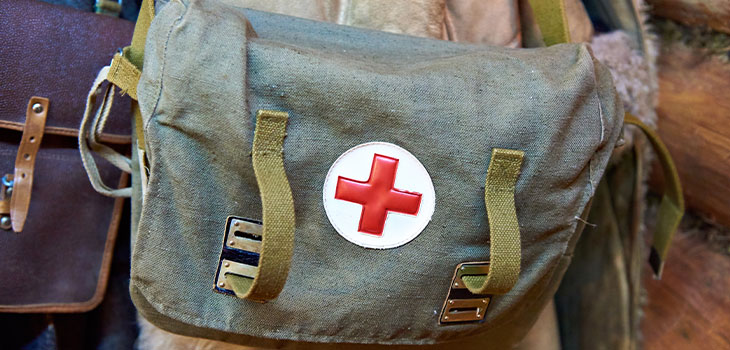

A decade after the world pledged to better protect healthcare in war, the situation is moving in the opposite direction. Across today’s conflicts, attacks on hospitals, ambulances and healthcare workers are increasing in frequency and severity, despite clear protections under international humanitarian law.
According to leading authorities, these attacks, are increasingly being used as a tactic of war rather than remaining an unintended consequence of conflict. This shift has placed civilians and those providing life-saving care at grave risk while raising profound concerns about the erosion of international humanitarian law and the protections it affords healthcare.
The consequences are far reaching beyond the war wounded. According to the International Committee of the Red Cross (ICRC), it profoundly disrupts an essential civilian service. For example, over 400 attacks on maternal health care services have harmed pregnant women and newborns and have left families and communities devastated.
As attacks on healthcare have increasingly become widespread, they are not a new phenomenon. Recognising the growing severity of the issue the United Nations Security Council adopted Resolution 2286 in 2016 to strengthen the protection of healthcare workers, patients and medical facilities during armed conflict. Ten years later, however, the resolution has not achieved the level of protection it sought.
In fact, attacks on healthcare have continued to increase over the years. In 2025 alone, the World Health Organization (WHO) recorded 1,348 attacks on healthcare worldwide, resulting in almost 2,000 deaths- more than twice the number reported in 2024. Further, the failure to ensure meaningful accountability for many of these assaults has fuelled concerns that international humanitarian law is being increasingly disregarded, undermining the protections it was designed to provide.
On the 10th anniversary of Resolution 2286, leading humanitarian organisations including the WHO, Médecins Sans Frontières (MSF) and the ICRC in a joint statement, highlighted these failings, warning that as violence against healthcare has “continued and, in many contexts, intensified”, stating that the failure to protect healthcare as both a humanitarian crisis and a crisis of humanity.
MSF Legal Director Claude Mahon said the promise of Resolution 2286 “lies in ruins”, arguing that attacks on healthcare have become normalised in modern conflict.
“The normalisation was not inevitable, but permitted incident by incident, year after year,” he said in a separate statement to the UN Security Council. “It’s as if attacks on healthcare were an acceptable cost of war.”
“Every attack on humanitarian personnel that passes without consequence allows this insidious pattern to continue,” Permanent Observer to the United Nations at the UN Security Council, Elyse Mosquini said in a statement.
“Each such attack signals to others that the lives of aid workers are expendable, and that the rules of war and the protections they are designed to provide are disposable,” she said.
Adding to the concern, experts have warned that attacks on healthcare are also entering a new phase. The increasing use of drones, autonomous systems and other emerging AI military technologies is making hospitals, ambulances and healthcare workers more vulnerable than ever, raising fears that without stronger accountability and enforcement, attacks on healthcare will continue to escalate.
“New risks are also emerging. The use of AI-enabled systems in military operations may influence targeting and operational decisions, but this must not undermine the protection owed to civilians, medical personnel and facilities,”Ms Mosquini said.
Australia’s role
Australia is a signatory to the Geneva Conventions and has long committed to upholding international humanitarian law. The Australian Government has reaffirmed that medical and humanitarian personnel must be respected and protected in all conflicts when in 2025, it helped launch the Declaration for the Protection of Humanitarian Personnel, aimed at strengthening protection and accountability for attacks on aid and health workers. To date 112 Member states have endorsed the declaration, however the declaration is not legally binding. In a recent Statement to the 79th World Health assembly, the Co-Chair of the group driving the Declaration (Friends of the Declaration to the Protection of Humanitarian Personnel) reiterated in the face of increasing attacks on healthcare that now was the time to act on their collective commitment to respect and uphold international law.
Around the launch of the Declaration in 2025, nurses and midwives concerned by the growing number of attacks on healthcare, joined the ANMF’s Nurses and Midwives for Peace campaign, signing a petition calling on the Australian Government to do more to protect healthcare workers and facilities in conflict zones.
The petition urged the Government to condemn attacks on healthcare, support accountability for violations of international humanitarian law and advocate for stronger protection of healthcare workers globally.
The ANMF forwarded the petition to the Department of Foreign Affairs and Trade (DFAT), seeking a response on what action Australia is taking to uphold the protection of healthcare in conflict.
In its response, DFAT outlined Australia’s longstanding commitment to international humanitarian law, support for the Geneva Conventions and efforts through diplomatic channels to promote the protection of civilians, humanitarian personnel and healthcare services during armed conflict.
The response also highlighted Australia’s support for international initiatives aimed at improving compliance with international humanitarian law and strengthening accountability mechanisms.
However, while acknowledging Australia’s commitments, it’s evident that attacks on healthcare continue to rise globally and that more needs to be done to ensure health personnel and their patients are protected. The ANMF is now considering its next steps in advocating for stronger protections for healthcare workers, patients and health facilities affected by conflict.
As nurses and midwives witness firsthand the importance of safe access to healthcare, the campaign serves as a reminder that protecting healthcare in war is not only a legal obligation under international law but a fundamental humanitarian responsibility.
Healthcare should never be a target.