
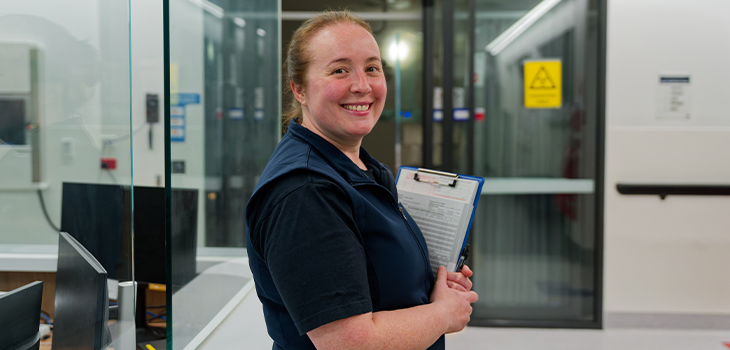

As part of Australia’s first wave of registered nurses studying to become designated RN prescribers, Tasmanian mental health nurse Emily Brinckman is already picturing what the expanded scope of practice could mean for patients.
Working as a Clinical Nurse Specialist (CNS) at Royal Hobart Hospital’s Emergency Department, Emily assesses patients presenting primarily with mental health concerns. Her role involves providing support and specialist expertise to both patients and ED staff so that this vulnerable cohort receives the most appropriate treatment and care planning.
Emily is studying to become an endorsed designated RN prescriber through the University of Tasmania, one of five approved courses currently offered nationwide.
She believes being able to prescribe Schedule 2, 3, 4 and 8 medicines in partnership with an authorised health practitioner could significantly improve patient flow and timely access to treatment within the ED.
“I’m excited for when I see a patient in distress and can be able to promptly get them some medication in addition to the non-pharmacological support we already provide,” she says.
Emily has worked across a wide range of mental health settings throughout her career. Beginning as an enrolled nurse in private mental health, she later moved into forensic mental health before completing her RN qualification. She secured a new grad Transition to Practice program in mental health, then undertook a Post Graduate Diploma in Mental Health Nursing. Since then, she has worked in inpatient mental health, community mental health, and correctional health and forensic settings, before joining Royal Hobart Hospital’s busy ED.
Emily first became aware of the landmark introduction of RN prescribing in Australia late last year as the Nursing and Midwifery Board of Australia’s (NMBA) registration standard officially came into effect. Around the same time, she had begun considering further study to become a nurse practitioner (NP) but shifted her focus after learning that the University of Tasmania would be offering an RN prescribing course because she believes it provides a solid foundation for undertaking their Masters’ program.
“Anyone who knows me knows that I’m always studying something. I’ve always got something that I’m working on,” she says. “So, it was just a natural progression for me.”
For Emily, the potential day-to-day benefits of RN prescribing are clear.

“In my role, for example, I’m already doing a best possible medication history,” she explains.
“I’m already cross-referencing that across various sources. Then I write down the list of medications that I need to be charted and then I take them to the emergency doctor because there’s not necessarily a psychiatrist on site after hours. So, I take them to the ED doctor, who might have never met the patient and isn’t involved in their care, to check.”
Once up and running, Emily believes the designated RN prescribing model will cut a lot of red tape and optimise care.
“The benefit is it’s going to improve patient flow, reduce the need for me to tap those emergency doctors on the shoulder and say, ‘Oh, can you actually do this for me?’” she says.
“I’m doing 90% of the work, the next 10% is just charting those medications.”
Emily says the ability to prescribe medications through an expanded scope of practice will improve the experience of patients experiencing acute mental health distress.
“If I was able to prescribe them, say an anxiolytic medication, then that’s going to improve their experience in the emergency department,” she argues.
“It’s going to reduce the need for me to go and involve other clinicians, which just takes longer. It takes longer for the service; it takes longer for the patient.”
The University of Tasmania’s Graduate Diploma level RN Prescribing Pathway, delivered fully online and part-time, covers eight units. In year one, the four units of study relate to the student’s area of speciality. In year two, a further four units – evidence-informed practice, medical principles for advanced nursing and midwifery, advanced health assessment, and clinical perspectives of therapeutic medication management are completed.
Emily explains: “I already have a University of Tasmania Graduate Diploma in Mental Health Nursing, so, I have credits for five units, leaving only three to do for this new Graduate Diploma. Some unis are offering prescribing courses at a graduate certificate level, so, I just encourage nurses to have a look around at the options.”
To apply for the endorsement after completing an NMBA-approved course, nurses must have three years’ full-time post initial registration clinical experience (5,000 hours) as an RN within the past six years. Once endorsed, and in clinical practice, they are required to complete a six-month clinical mentorship with an authorised health practitioner such as a nurse practitioner or doctor.
So far, Emily has undertaken units focusing on physical health assessment and pharmacology, which she says has deepened her understanding of medications she already administers regularly.
“It’s really helped me to understand the psychiatric medications that I’m already giving to patients,” she says.
“There is quite a deep level of understanding that we’re expected to demonstrate.”
Emily was fortunate to secure scholarships under the University of Tasmania’s industry partner agreement, as well as and the Tasmanian Government, to support her study.
In its early days of implementation, Emily acknowledges there is considerable work ahead before designated RN prescribers are fully integrated into health services.
“I expect with such a significant change, services will be moving slowly and cautiously to ensure patient safety.”
One of the biggest unresolved questions from nurses remains whether they will be paid more for taking on additional clinical responsibility and risk.
Emily is hopeful that nurses who become RN prescribers will receive higher pay. Promisingly, the ANMF is pursuing appropriate remuneration for increased skills and responsibilities.
“I think it would be unreasonable to expect nurses to undertake the additional work and the additional risk … without appropriate remuneration,” she says.
As debate continues across the profession, Emily believes many concerns about RN prescribing will ease once nurses and other health professionals understand the safeguards built into the model, such as the six-month mentorship.
“The guardrails are there for patient safety and for our professional safety,” she says.
“Once that’s explained, people seem to get on board.
“Some of the concerns I’ve heard nurses raise include, ‘Oh, I don’t want this extra responsibility.’ Well, that’s fine – it’s opt-in. No one is forcing registered nurses to prescribe medications.”
Emily also rejects suggestions that designated RN prescribing could threaten the role of nurse practitioners, instead viewing it as part of nursing’s broader professional evolution.
“I think it’s important to recognise that nurse practitioners can work without a partnership arrangement with a doctor and designated nurse prescribers cannot,” she points out.
“Nurse practitioners are safe. We still really need nurse practitioners in the service. My ultimate hope is that the option to do the nurse prescribing course will make the path to becoming a nurse practitioner in the future feel more accessible for nurses.
“Ultimately, this is just one pathway and as nurses, we should all be lifting each other up. We should be aiming to collectively raise our scope, our voice, and contribution to the healthcare service.”
Looking ahead to completing the course in October this year, Emily says she remains excited about what the future could hold — both for patients and for the profession itself.
“Nursing is an ever-evolving area, and we should be proud of that and embrace that,” she says. “I think when I first write on a medication chart, I might feel really naughty. I’ll have to remind myself that I’m actually allowed to do that.”