


As the Australian Nursing and Midwifery Federation (ANMF) pursues its landmark Nurses and Midwives Work Value Case before the Fair Work Commission (FWC), general practice nurse Adama Luminous-Akazua says the push for long-overdue wage increases is about far more than money – it’s finally recognising the value and complexity of the work nurses, midwives and assistants in nursing (AINs) do.
“It’s not necessarily the monetary aspect of it,” she explains, when asked what difference a pay bump would mean for her personally.
“My wellbeing will improve, first and foremost. There’s a significant mental burden in not feeling valued for the work you do. We all just want to be appreciated.”
The ANMF’s case is seeking to vary the Nurses Award 2020 to increase minimum award wage rates for nurses, midwives and AINs, arguing that their work has been historically undervalued – particularly due to gender-based reasons – and that the increasing complexity, responsibility and skill required in the role is not adequately recognised in current pay settings. It follows the ANMF’s successful Aged Care Work Value Case, which achieved minimum award wage increases of between 15-30% for aged care nurses and care workers.
The case is also calling for the award to be changed to the Nurses and Midwives Award, improvements to the classification structure, pay point progression for enrolled nurses, and additional wage increases for nurse practitioners. It affects nurses, midwives and AINs working across a wide range of health settings like general practice and community health.
A New South Wales Nurses and Midwives’ Association (NSWNMA) member, Adama has worked in general practice for three years and has developed a strong passion for primary healthcare nursing.
Working in a Medicare Urgent Care Clinic attached to a general practice in Liverpool, western Sydney, no two shifts are the same, with a constant flow of varied presentations.
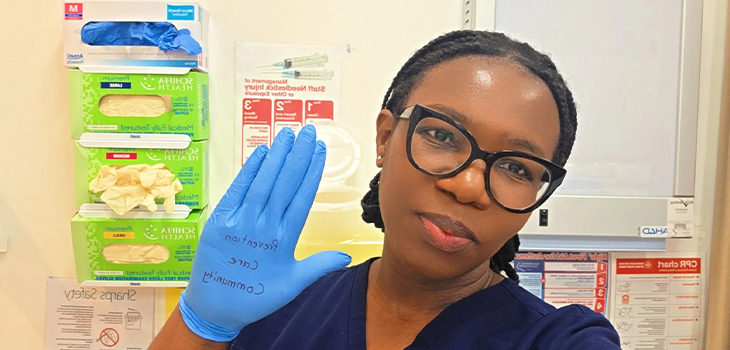
General practice nurse Adama Luminous-Akazua is hopeful the value of nurses and midwives will be finally recognised. through the ANMF’s landmark Work Value Case.
A registered nurse, Adama is primarily responsible for triaging patients at the walk-in clinic, identifying those that require medical attention and assisting with care ranging from suturing and nebulisation through to managing and escalating serious cases.
“You never know who’s coming through the door,” she says.
Yet, despite the complexity of the role and skills required, she believes primary care is grossly underestimated and undervalued.
“General practice is primary care to the community, providing the first line of contact,” Adama points out.
“When people have the flu or a headache, they come to us. We play a crucial role in reducing unnecessary hospital presentations.
“But it doesn’t stop there. When patients do attend hospital, they often return to us for follow-up care and management.”
Adama says her role as a general practice nurse extends well beyond minor injuries and illnesses. For example, it includes ongoing education, care planning and monitoring for patients with complex and chronic illnesses.
“We’re more than flu shots and wound dressings,” she says matter-of-factly.
That breadth of work and level of skill, the ANMF argues, has never been properly reflected in award wages, due to deep-seated gender-based assumptions about women’s work. Put simply, over the past couple of decades, the work carried out by nurses, midwives and AINs has become more complex, requires greater skill and responsibility, and more education and training to provide quality care to Australians.
For Adama, the significance of the current pay disparity between nurses, midwives and AINs working under the Nurses Award 2020 and those covered by enterprise bargaining agreements performing similar work reaches far beyond her own pay packet.
“It just feels like we are being undervalued and not appreciated for the work we do,” she says.
“In healthcare, we are all working for the good of the patients. But if there’s any sector to focus on, it would be primary care – because when primary care is strong, fewer people end up in hospital.”
Adama says the pay disparity makes primary care a less attractive proposition, with many nurses leaving general practice for other roles offering significantly higher wages, ultimately at the expense of vital preventative patient care.
“There’s this huge turnover,” she reveals. “People are willing to leave the job for a better opportunity in the hospital because of the pay.
“It leaves the rest of us wondering why we’re doing all this work, under such pressure, for this level of pay.”
If the FWC grants higher ward wages for nurses, midwives and AINs working under the Nurses Award 2020, Adama believes it would improve both workforce retention and morale. She is confident fairer pay would encourage many experienced nurses to return to primary care.
“I think they’ll come back,” she says.
“And not because they feel like the job is easier. They will come back because they feel valued.”




4 Responses
Couldn’t agree more! As a GP EN of almost 7 years I am still on a lousy rate even after requesting a pay rise. According to fair work $30 an hour is adequate for the work we put in, but we as GP nurses have to be triage nurse, emergency nurse, mental health nurse, wound care nurse, advance care planning nurse, grief counsellor, immunisation nurse, ATSI nurse. And then we have to do all the behind the scenes things like stocktake, ordering immunisations and consumables. Ensuring the GP’s have enough stock in their rooms, call backs plus much more. It is very soul crushing to see that all the effort in getting wages raised goes towards aged care and hospital staff, when the acute care nurses just get left behind.
This is sooooooooo true. In addition to this we have to supervise “unofficially” new overseas Doctors who are attending procedures on patients with little to no experience.
I believe the work we do is very underestimated.
To add to this, the reduction in time allowed for Care plans and Health Assessments as of the 1st of July 2025 has made the process so much harder to keep in the time frame that can blow out if multiple needs identified.
As an Ed trained nurse who has recently moved into primary and Aboriginal health care, i could not agree more with you. My work still involves emergency and life threatening situations and by no means is bland or boring. But….when I tell people where I work, the looks and response include questions and looks of why with a tone of negativity ans questions of…”oh and how are you liking that?… (they act like i have left my important work and taken a step backwards). I am very proud and satisfied with the current work I do and I know that it is very important and needed and that Primary Care is a very important and required role. It just doesn’t seem to be recognised or respected as this.
Would love to see a pay increase for GP nurses in Victoria. Also well overdue.