

After decades tending to patients’ health and welcoming newborns into the world, a growing group of retired nurses and midwives are discovering a new kind of caregiving – one centred on building connection, community and belonging.
For these women, volunteering with Spark offers a new chapter of contribution defined by generativity: the deep human desire to give back, nurture others and leave their community stronger.
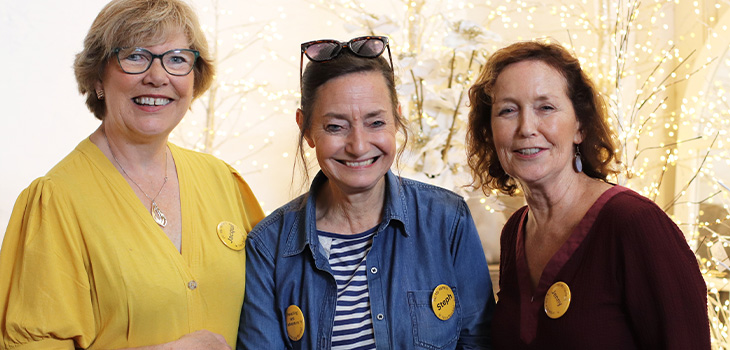
Spark creates community-led solutions to loneliness by engaging volunteers, activating places and spaces, and building local connection systems. In the Adelaide Hills, retired nurse-midwife ‘Sparkies’ Jenny, Stephanie and Jacqui help people who may be lonely or simply seeking stronger connections, find their spark, through coffee catch-ups, active walks and creative sessions. Sparkies are the social wiring, ensuring connections thrive by building trust and a sense of belonging. The women have diverse experience across neonatal care, infection control, aged care, intensive care, cardiac and cancer. One thing unites them – the capacity and need to care for others, with Jenny noting “the caring never leaves you”.
We are facing an epidemic of loneliness. One in three Australians feel lonely,1 costing the economy $2.7 billion annually through increased healthcare costs and lost productivity.2 It was declared a public health priority by the World Health Organization, describing wellbeing as a balance of physical, mental and social health – whereby addressing loneliness will benefit health and mental wellbeing.3 Jenny has seen how loneliness affects people – they may stop caring for themselves, and their physical or mental health can decline. The impact of loneliness on mortality is equal to that of smoking, obesity, and physical inactivity.3
Their careers have empowered these women with transferable skills – active listening, emotional support, and problem-solving. For Jacqui, nursing has taught her to listen deeply, creating space for people to tell their story in their own time. She focuses on being present rather than offering advice or trying to ‘fix’ someone.
When the opportunity arose to be part of Spark, nurse-midwife Jenny immediately loved the idea – bringing skills in engaging effectively with different personalities, de-escalating situations and listening deeply. Stephanie loves inspiring confidence in others and seeing them flourish. She notes that cultural change in the digital age, and lesser emphasis on community, had huge implications for the high rates of loneliness we now see.
Generativity, coined by psychologist Erik Erikson, is driven by social interaction and is important for emotional wellbeing as we age.4 Generativity has always been woven through nursing and midwifery; professions built on trust, listening and care across generations. Retirement doesn’t erase those instincts – it simply redirects them. Volunteers report a sense of purpose that has a significant, evidence-based preventive effect on mental health,5 while also supporting positive mental health for others. The impact ripples outward.
Through Spark, nurses and midwives continue what they have always done best, help people feel seen, supported and connected. This is generativity in action: volunteers investing in the social fabric, strengthening bonds across age, culture and circumstance.
Learn more at sparkconnection.org.au
Acknowledgements: With heartfelt thanks to volunteer Sparkies Jenny Semczuk, Jacqui McLean, and Stephanie Richards for their time and insights on this important topic.
References:
1 Ending loneliness together. State of the Nation Report – Social Connection in Australia 2023. 2023.
2 Duncan A, Kiely D, Mavisakalyan A, Peters A, Seymour R, Twomey C. & Vu L. Stronger together: Loneliness and social connectedness in Australia. Bankwest Curtin Economics Centre; 2021.
3 World Health Organization. Social isolation and loneliness among older people: Advocacy brief. Geneva: Switzerland; 2021.
4 Erikson EH. Childhood and society: Norton New York; 1963.
5 Pfund GN, Spears I, Norton SA, Bogdan R, Oltmanns TF, Hill PL. Sense of purpose as a potential buffer between mental health and subjective cognitive decline. International Psychogeriatrics. 2022;34(12):1045-55.
Authors:
Dr Jodie Scott BPsych(Hons), PhD, Research Fellow, Rosemary Bryant AO Research Centre, Adelaide University, South Australia
Associate Professor Nadia Corsini PhD, Senior Research Fellow, Rosemary Bryant AO Research Centre, Adelaide University, South Australia
Professor Marion Eckert DNurs, MPH, MNSc, Industry Professor of Health Innovation and Enterprise, Rosemary Bryant AO Research Centre, Adelaide University, South Australia