


As 2025 ends, you may find yourself reviewing your year. Are there things you might have done differently? Have you developed habits that don’t serve you well? If you’d like to set new intentions for 2026 and replace old habits, the Nurse Midwife Health Program Australia (NMHPA) can help.
If you’re not familiar with NMHPA, we’re a free, independent peer support service run by nurses and midwives, for nurses and midwives (and students). We’re a safe place to speak openly and feel heard by someone who genuinely understands your work. Jump onto our website to learn more.
Review – take a minute
Let’s review those auto-pilot behaviours and understand why you do them. Does a specific situation, action or feeling always lead you to this place? What need is being met? Figuring this out is key to replacing habits.
“Before you focus on the habit itself, take a moment to understand the intention behind it and what you want to achieve” says Martine – NMHPA Clinician.
Set a habit intention
Cue your new behaviour. What are you going to do, and how can you give yourself the best chance of making this new behaviour a habit? Our tip is to make it small. This will help your brain learn this new behaviour. And link it to something you already do often.
Cues for shift workers
Some cues work better than others. For shift workers, time cues such as “I’ll do this at 7pm” can be hard to stick to because the schedule is never the same.
Event-based cues such as “I’ll do this after I…” are stronger and more reliable.
For example: “After my first meal of the day, I’ll do a two-minute stretch.”
This is a stable cue; it doesn’t matter if that meal happens at 6.30am or 4.20pm. That stability makes the habit easier for your brain to learn.
Case study: changing a habit, one drink bottle at a time
Alex, an RN in a busy city hospital shares the steps she took to form a new habit:
- Review: “I rush around, forget to drink water and go home with a headache every day.”
- Intention: “I want to drink more water.”
- Cue: “I will fill my drink bottle before I leave my shift so I can hydrate on the way home…”
- Result: “2 weeks in and most days I drink more and have had fewer headaches. I think I’ve forgotten to refill only twice so far.”
Drinking more water might seem like a small task – but as busy professionals we know it’s not always easy in reality. These tiny changes act like building blocks, slowly contributing to bigger improvements in our wellbeing without overwhelming us.

Put it into practice
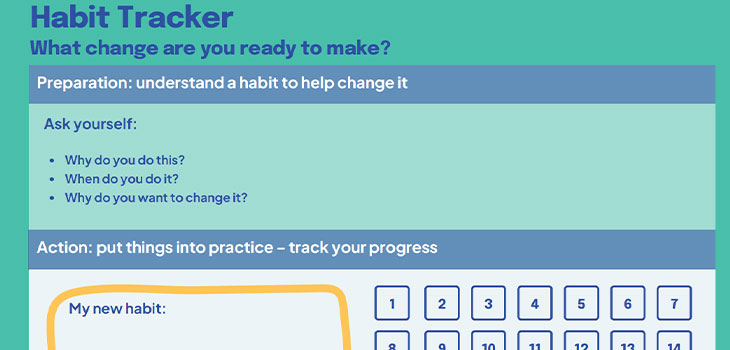
Read our step-by-step guide to building new habits. Download our habit tracker and put it on the fridge or inside your locker. Write down your intended new habit, put it into action and track your progress.
Keep at it
Forget ‘21 days to change a habit’; it’s a myth. Everyone is different and the evidence tells us that the time it will take to form a habit depends on the individual and the complexity of the habit.
Talk it through if you need
If shifting a habit brings up strong emotions, guilt, self-criticism or deeper stress, you don’t have to face it alone. NMHPA’s peer clinicians – all nurses or midwives -understand the realities of working in these professions and can support you.
Examples like drinking more water or doing a quick stretch might not require deep reflection – but other patterns and behaviours absolutely do. If you’d like support reflecting on why a habit exists, or what sits underneath it, we’re here to help you explore that before you jump into making change.
We’ll remain open during regular business hours over the holiday period (except public holidays).
Call us on 1800 001 060 or send us an email info@nursemidwifehpa.org.au