

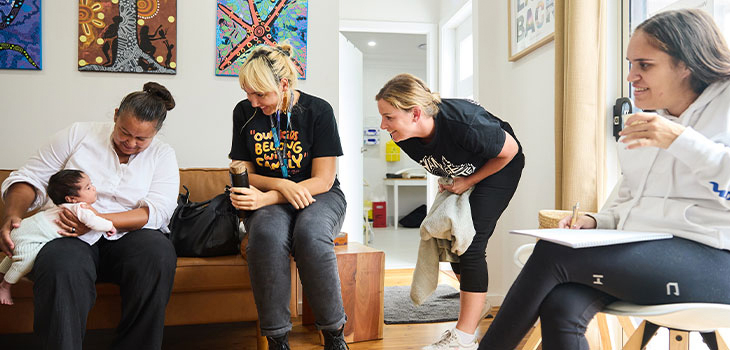

New research shows better outcomes with Birthing on Country compared to mainstream maternity services for First Nations families.
First Nations women had significantly more normal vaginal births, were more likely to be exclusively breastfeeding upon hospital discharge and had greater engagement with culturally safe wellbeing programs.
The study, led by Charles Darwin University’s (CDU) Molly Wardaguga Institute for First Nations Birth Rights and Waminda South Coast Women’s Health and Wellbeing Aboriginal Corporation, evaluated the clinical effectiveness and wrap-around supports provided to women and their Aboriginal families by Waminda.
Aboriginal Community Controlled Health Organisation (ACCHO) Waminda, located in Nowra, NSW, provides integrated culturally safe primary health services to Aboriginal women and their families, a crucial component of which is its Birthing on Country program.
The research compared Waminda’s Birthing on Country service, outcomes and frequence of wrap-around services used by women pregnant with Aboriginal babies to standard hospital maternity care.
From 2018 to 2022, Waminda provided continuity of midwifery care in pregnancy and postnatally, with women giving birth at the local hospital with an unknown midwife.
Results
Infants born within Waminda’s integrated care and standard care had similar odds of being born preterm. However, babies who were cared for by Waminda had higher odds of being exclusively breastfed at discharge at 75.6% compared to 63.3% with standard care.
Women in the Waminda cohort were more likely to have spontaneous onset of labour at 48.9%, and spontaneous vaginal births at 71.7%, with the odds of using epidural pain relief reduced by 39% compared to standard care.
Of significance, more than 90% of women who were receiving Waminda’s maternity care also received additional support from at least one of Waminda’s comprehensive wrap-around services, with some women receiving services from up to six different Waminda programs during pregnancy.
The strength of Waminda’s holistic, community-controlled model, addresses clinical care and broader social and structural factors shaping women’s lives, from poverty and unemployment to domestic and family violence and social and emotional wellbeing.
The results provided significant insights into creating effective models of care and support for expectant mothers, said lead author Professor Yu Gao with the Molly Wardaguga Institute.
“For the first time, we’ve been able to quantify Waminda’s wrap-around programs and use network analysis to visually demonstrate how different programs interact to support women throughout pregnancy and after birth. What we have learned, we can apply to other Birthing on Country sites.”
Strength-based care
In 2024, Waminda successfully launched its 24/7 Minga Gudjaga Midwifery Practice, where women receive continuity of midwifery care from a known midwife from conception to six weeks postpartum.
The enhanced service delivery, is aimed at improving outcomes for women and their Aboriginal babies, said Waminda’s Birthing on Country Executive Manager Melanie Briggs.
“Waminda’s wrap-around support programs provide strength-based care that addresses the social determinants of health affecting women’s lives. This approach is a key point of difference between Aboriginal community-controlled services and standard hospital-based maternity care.”
The study reinforces the importance of Aboriginal leadership in maternity care, said Molly Wardaguga Institute Director Professor Yvette Roe.
“When Aboriginal communities lead maternity services, women are better supported to birth and care for their babies in culturally safe ways.
“If governments are committed to closing the gap in maternal and child health, Birthing on Country must be implemented nationally and properly funded. Investment should flow to the Aboriginal Community-Controlled sector, where services are designed by community, for community.”
The research is published in The Lancet Regional Health – Western Pacific journal




One Response
I am so happy to read this article. The continuity of care model has evidence of improving health outcomes for all women. Empowering women to birth is better for women & their families & cost saving for the health care system. Training in the UK was suggested to me (in Australia) due to my interest in working rural & remote. My interest being to assist women to birth on country, rather than being transferred to a metro hospital, away from their community & people. This suggestion said to all. Systems can destroy confidence with women. Continuity of care provides education & support with all women enabling themselves to trust to birth.