

Over recent years, nurses, midwives and care workers have helped drive significant reforms made to healthcare and the professions they work in. This has included advances in gender equity; industrial relations reforms including wage increases through the Aged Care Work Value Case, stronger delegate rights; and long-awaited improvements in aged care with 24/7 registered nurse coverage and mandated care minutes.
Meanwhile there has been health reform that has expanded scope of practice for endorsed midwives and nurse practitioners while most recently RN prescribing standard has been introduced.
While these reforms mark real progress, their full impact is yet to be fully realised by those working on the ground. For example, some aged care providers are still failing to pass on the full wage increases to staff, even though they are funded by taxpayers to do so.
The ANMF remains focused on ensuring every reform translates into meaningful, tangible improvements for nurses, midwives, care workers, and the communities they serve. In 2026, our mission is clear: enforceable standards, fair pay, safer workplaces, and health centred policies that deliver genuine change on the floor, not just promises on paper.
Nurses and Midwives for Peace
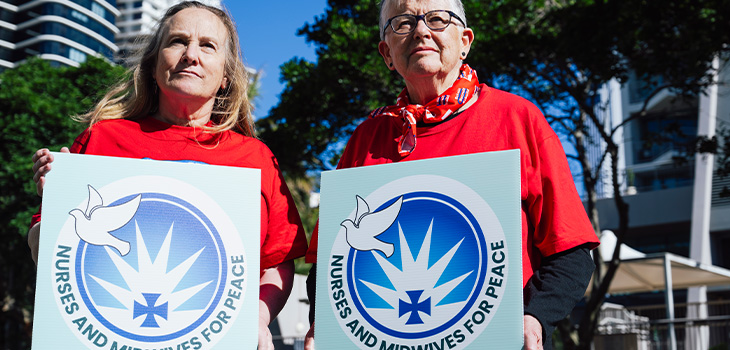
In July 2025, the ANMF launched the Nurses and Midwives for Peace campaign in response to escalating conflicts in Gaza and Ukraine, which have claimed the lives of countless healthcare colleagues worldwide.
Across the globe, war and violence devastate communities, destroy critical infrastructure, and increasingly target healthcare workers, their facilities, and the patients they serve. The ANMF stands as a voice for global peace, calling for an end to violence that threatens our shared humanity.
- Without peace, humanitarian needs cannot be met.
- Without safety, healthcare systems cannot function.
- Without protection, nurses and health workers cannot deliver life‑saving care.
In 2026, the ANMF will continue to stand alongside frontline nurses and healthcare workers, advocating for an immediate ceasefire and a lasting peace.
Climate change
The ANMF, in partnership with The Lancet Countdown on Health and Climate Change, has released a national policy report urging the federal government to place health at the centre of climate policy. The report identifies three urgent priorities to safeguard the health of Australians and build a climate resilient‑ future:
- Establish a national clean air framework to protect public health
- Invest in the implementation of a national health and climate strategy
- Redirect fossil fuel subsidies toward health and climate resilience
Australia’s first National Climate Risk Assessment, released in September, confirms the nation faces increasingly frequent and severe climate hazards. In response, a delegation of union leaders and frontline workers, including nurses, firefighters, and teachers, travelled to Canberra in November to launch Work Health and Safety in the Era of Climate Crisis, a report outlining the escalating risks to worker safety and the urgent reforms required as temperatures rise.
The ANMF and its members will continue to engage with policymakers, health organisations, and key stakeholders to ensure that Australia’s climate commitments reflect the health needs of the nation.
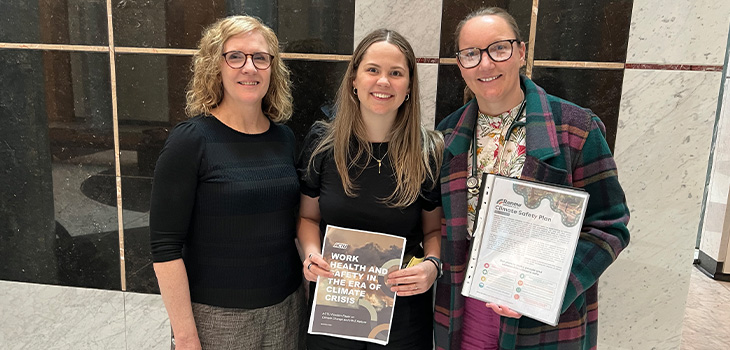
L-R ANMF Federal Secretary Annie Butler, ANMF Climate Change Officer Catelyn Richards and ANMF Victorian Branch member Sigrid Pitkin
Racism in healthcare
The ANMF remains focused on ensuring every reform translates into meaningful, tangible improvements for nurses, midwives, care workers, and the communities they serve. In 2026, our mission is clear: enforceable standards, fair pay, safer workplaces, and health centred policies that deliver genuine change on the floor, not just promises on paper.
The Australian Human Rights Commission has laid bare the devastating impact of racism on health outcomes for Aboriginal and Torres Strait Islander peoples and other communities across Australia. Its Health Inequities in Australia scoping review found that racism, both systemic and interpersonal, is a critical driver of poor health, chronic illness, and premature death.
“When you go into the healthcare system and you identify as an Aboriginal person, people’s demeanour changes straight away. We sort of knew that this discrimination existed but after the referendum it really came out. People don’t think racism is still an issue.” — Aunty Maureen.
Research conducted by the NSW Nurses and Midwives’ Association (NSWNMA, ANMF NSW Branch) in 2025 revealed that nearly two thirds‑ of nurses, midwives, and care workers from culturally and linguistically diverse (CALD) and/or Aboriginal and Torres Strait Islander backgrounds reported experiencing racism. The findings showed little progress since the 2019 report, which exposed systemic racism as widespread in the workplace. The ANMF will work with its state and territory Branches to drive meaningful change, collaborating with the Australian Human Rights Commission to strengthen racism education and reporting. This includes lobbying federal and state governments to adopt health-based‑ recommendations within the National Antiracism‑ Framework.