
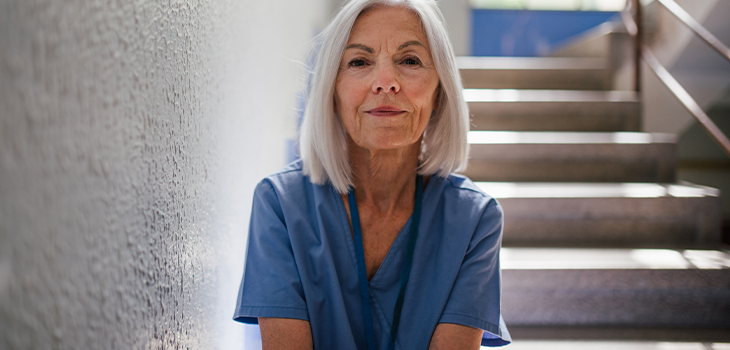

The global nursing and midwifery workforce is undergoing a profound demographic shift, with an increasing proportion approaching retirement age.1
This trend is pronounced in high-income countries like Australia, where an ageing population is simultaneously increasing demand for healthcare.2 In Australia, 38% of nurses and midwives are over the age of 45 years.3 Older nurses and midwives bring extensive expertise, clinical judgement, and mentoring; however, they also face unique challenges.4 These challenges are gendered as 89% of nurses and 93% of midwives are women.5 This article explores some of the social, health, and wellbeing challenges that are experienced by older female nurses and midwives.
Lifestyle
There is evidence of increasing obesity, decreasing physical activity, poor diet, smoking, and excessive alcohol intake among nurses and midwives.6 Fatigue after work is regularly reported as a barrier to engaging in regular physical activity.7 Further, nurses and midwives report that shift work makes healthy eating difficult.8 Older female nurses and midwives may be drinking at levels that may pose a significant risk to their health and wellbeing which is complicated by a “culture of permissibility”.9
Mental health
Internationally, the midwifery workforce is in crisis – with 20% of midwives suffering severe symptoms of depression, anxiety, and stress.10 A similar picture exists in nursing where the rates of anxiety and depression are increasing.11 Concerningly, there is evidence that nurses and midwives are at a higher risk for suicide compared to the general population.12 Pre-existing mental health conditions can be exacerbated by work patterns, and older nurses report poorer mental health resulting in earlier retirement.13
Perimenopause and menopause
Available evidence indicates that during perimenopause and menopause, nurses’ quality of life is negatively impacted by high stress levels and unstable work patterns.14 One quarter of nurses and midwives in Australia fall into the age for perimenopause and menopause,3 therefore greater attention is needed to support them to manage the myriad of difficult symptoms and co-morbidities. For example, the often-unrecognised collective of musculoskeletal symptoms15 needs greater attention given already high rates of carer-limiting work-related musculoskeletal injuries sustained from years of accumulated manual handling16 and increasing patient obesity.17
Intimate partner and family violence
Nurses and midwives experience higher rates of abuse and violence from intimate partners.18 Older women are more likely to be victims/survivors of both intimate partner and family violence.19 Nurses and midwives often prioritise the care of others over their own wellbeing, which can delay recognition of abuse/violence or seeking assistance, reinforcing cycles of harm.20 Nurses and midwives who experience intimate partner or family violence are more likely to end up quitting.21
Divorce and financial security
Divorce rates among older women are increasing, and older divorced women face economic disadvantage due to systemic gender pay gaps, career breaks for caregiving,22 and underfunded superannuation for lower-paid positions.23 Additionally, women returning to the workforce seeking flexibility for caring responsibilities may opt for part-time work, further contributing to this gap. A report from Super Members Council23 found that older women’s super-balances are also disproportionally impacted by events later in life, including early retirement to care for elderly family members. Nearly 60% of older women who rent live below the poverty line, therefore, older female nurses and midwives may find themselves resiliently working longer for a secure and dignified retirement.24
Caring responsibilities
Known as the ‘sandwich generation’, older women are caught between meeting the needs of growing children, ageing parents, grandchildren, and work.25 The squeeze is felt more by women due to the gendered nature of care at both work and home; women, aged between 50-69, are the biggest providers of unpaid, ongoing care at home.26 Time away from work for caring contributes to their financial disadvantage. In addition, caregiving may impact the health and wellbeing of the caregiver, increasing their risk of other health conditions.27,28
Cancer and survivorship
Almost one in two Australians will be diagnosed with cancer by the age of 85.29 Nurses and midwives are no exception – the International Agency for Research on Cancer has classified rotating shift work as ‘probably carcinogenic to humans’.30 Studies suggest that long-term circadian disruption may play a role in rectal31 and breast cancer32 development. Nurses and midwives working rotating shifts are less likely to undertake bowel and breast cancer screening than people who work office hours.33 In addition, nurses have reported mental distress following a cancer diagnosis as they switch between being a provider and recipient of healthcare.34
Conclusion
Older nurses and midwives are essential to the health of the nation – our healthcare system could not function without their skills, knowledge, compassion, and mentorship. Yet, they face complex social, health, and wellbeing challenges that threaten their ability to remain in practice. These realities highlight the urgent need for a fundamental rethink on how workplaces support older nurses and midwives.
References
1 Rodwell J. Prospective Drivers of Nurses’ Partial or Complete Retirement Seven Years Later: Work Ability and Physical Functioning Going against the Tide of Age. International Journal of Environmental Research and Public Health. 2022;19(18):11159.
2 Australian Institute of Health and Welfare. Older Australians: Demographic Profile 2024 [Available from: https://www.aihw.gov.au/reports/older-people/older-australians/contents/demographic-profile.
3 Nursing and Midwifery Board. Nursing and Midwifery Board of Australia: Registrant Data 2025 [Available from: https://www.nursingmidwiferyboard.gov.au/About/Statistics.aspx.
4 World Health Organization. Ticking timebomb: Without immediate action, health and care workforce gaps in the European Region could spell disaster 2022 [Available from: https://www.who.int/europe/news/item/14-09-2022-ticking-timebomb–without-immediate-action–health-and-care-workforce-gaps-in-the-european-region-could-spell-disaster.
5 Nove A, ten Hoope-Bender P, Boyce M, Bar-Zeev S, de Bernis L, Lal G, et al. The State of the World’s Midwifery 2021 report: findings to drive global policy and practice. Human Resources for Health. 2021;19(1):146.
6 Perry L, Gallagher R, Duffield C. The health and health behaviours of Australian metropolitan nurses: an exploratory study. BMC Nursing. 2015;14(1):45.
7 Blake H, Malik S, Mo PKH, Pisano C. ‘Do as I say, but not as I do’: Are next generation nurses role models for health? Perspectives in Public Health. 2011;131(5):231–9.
8 Zhang Q, Chair SY, Lo SHS, Chau JP-C, Schwade M, Zhao X. Association between shift work and obesity among nurses: A systematic review and meta-analysis. International Journal of Nursing Studies. 2020;112:103757.
9 Schluter PJ, Turner C, Benefer C. Long working hours and alcohol risk among Australian and New Zealand nurses and midwives: A cross-sectional study. International Journal of Nursing Studies. 2012;49(6):701–9.
10 Bayram Deger V. Editorial: Anxiety, burnout, and stress among healthcare professionals. Front Psychol. 2023;14:1348250.
11 Maharaj S, Lees T, Lal S. Prevalence and Risk Factors of Depression, Anxiety, and Stress in a Cohort of Australian Nurses. International Journal of Environmental Research and Public Health. 2019;16(1):61.
12 Petrie K, Zeritis S, Phillips M, Chen N, Shand F, Spittal MJ, et al. Suicide among health professionals in Australia: A retrospective mortality study of trends over the last two decades. Australian & New Zealand Journal of Psychiatry. 2023;57(7):983–93.
13 Montayre J, Harris C, Li W, Tang L, West S, Antoniou M. Older nurses and work-related factors that impact their mental health and wellbeing: a qualitative systematic review. Contemporary Nurse. 2024;60(5):537–54.
14 Theis S, Baumgartner SJ, Janka H, Kolokythas A, Skala C, Stute P. Quality of life in menopausal women in the workplace – a systematic review. Climacteric. 2023;26(2):80–7.
15 Wright VJ, Schwartzman JD, Itinoche R, Wittstein J. The musculoskeletal syndrome of menopause. Climacteric. 2024;27(5):466–72.
16 Stanchev V, Vangelova K. Musculoskeletal Disorders in Nurses in Hospitals. Open Access Macedonian Journal of Medical Sciences. 2022;10(E):439–43.
17 Huang SL, Cheng H, Duffield C, Denney-Wilson E. The relationship between patient obesity and nursing workload: An integrative review. Journal of Clinical Nursing. 2021;30(13-14):1810–25.
18 Kafle S, Paudel S, Thapaliya A, Acharya R. Workplace violence against nurses: a narrative review. J Clin Transl Res. 2022;8(5):421–4.
19 McLindon E, Hegarty K, Diemer K. ‘You can’t swim if there is a weight dragging you down’: Report into family violence against Australian nurses, midwives and carers. 2022.
20 Lyons K. Older women allegedly killed by family members a ‘silent crisis’, experts say. The Guardian. 2025.
21 Dheensa S, McLindon E, Spencer C, Pereira S, Shrestha S, Emsley E, et al. Healthcare Professionals’ Own Experiences of Domestic Violence and Abuse: A Meta-Analysis of Prevalence and Systematic Review of Risk Markers and Consequences. Trauma Violence Abuse. 2023;24(3):1282–99.
22 Chomik R, Piggott J. Australian Superannuation: The Current State of Play. Australian Economic Review. 2016;49(4):483–93.
23 Super Members Council. Securing a dignified retirement for more women. 2023.
24 O’Keeffe D. One in three older women living in income poverty in Australia: study 2016 [Available from: https://www.australianageingagenda.com.au/clinical/social-wellbeing/one-in-three-older-women-living-in-income-poverty-in-australia-study/.
25 Eeles S. Meet the ‘Sandwich Generation’ — the growing sector of women caring for their children and their parents. ABC News. 2023.
26 Council on the Ageing NSW. Submission: Inquiry into the recognition of unpaid carers. 2023.
27 Desai A, Chibnall JT. Chronic stress in elderly carers of dementia patients and influenza vaccine. The Lancet. 1999;353(9168):1969–70.
28 Bouchard K, Greenman PS, Pipe A, Johnson SM, Tulloch H. Reducing Caregiver Distress and Cardiovascular Risk: A Focus on Caregiver-Patient Relationship Quality. Canadian Journal of Cardiology. 2019;35(10):1409–11.
29 Cancer Council. Facts and figures: Current statistics in Australia n.d. [Available from: https://www.cancer.org.au/cancer-information/what-is-cancer/facts-and-figures.
30 International Agency for Research on Cancer. Known and Probable Human Carcinogens 2024 [Available from: https://www.cancer.org/cancer/risk-prevention/understanding-cancer-risk/known-and-probable-human-carcinogens.html.
31 Papantoniou K, Devore EE, Massa J, Strohmaier S, Vetter C, Yang L, et al. Rotating night shift work and colorectal cancer risk in the nurses’ health studies. Int J Cancer. 2018;143(11):2709–17.
32 Fagundo-Rivera J, Gómez-Salgado J, García-Iglesias JJ, Gómez-Salgado C, Camacho-Martín S, Ruiz-Frutos C. Relationship between Night Shifts and Risk of Breast Cancer among Nurses: A Systematic Review. Medicina (Kaunas). 2020;56(12).
33 Nicholls R, Perry L, Gallagher R, Duffield C, Sibbritt D, Xu X. The personal cancer screening behaviours of nurses and midwives. Journal of Advanced Nursing. 2017;73(6):1403–20.
34 Bonnamy J. Holding Multiple Identities: a Personal Narrative of Young Onset Colorectal Cancer. Journal of Cancer Education. 2020;35(6):1261–6.
Authors:
James Bonnamy RN MNurs, GradCertHlthProfEd, BN(Hons), BNurs, FHEA, AFANZAHPE, Advanced Life Support Registered Nurse, Authorised Nurse Immuniser, Research Fellow and PhD Candidate, School of Nursing and Midwifery, Faculty of Medicine, Nursing and Health Sciences, Monash University, Victoria, Australia and Patient Services Manager, Peninsula Health, Victoria, Australia
Viktorija Bonnamy RN Grad Dip Occupational Health and Safety, Grad Dip Counselling (Grief & Loss), Teaching Associate, School of Nursing and Midwifery, Faculty of Medicine, Nursing and Health Sciences, Monash University, Victoria, Australia and Acting Manager Health, Safety and Wellbeing, Clinical Nurse Consultant, and Patient Services Manager, Peninsula Health, Victoria, Australia
Dr Bethany Carr RM PhD, Master of Clinical Midwifery, BMid, Research Fellow, School of Nursing and Midwifery, Faculty of Medicine, Nursing and Health Sciences, Monash University, Victoria, Australia