


Palliative care supports people living with a life-limiting illness to have the best possible quality of life (1). This means providing: relief from distressing symptoms, support to make informed decisions, and care that aligns with what matters most to the person (1).
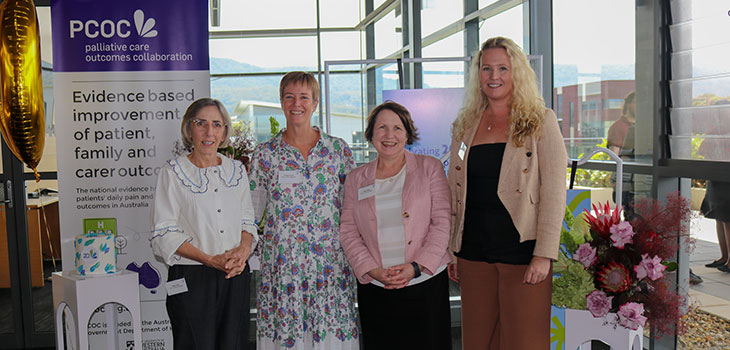
In Australia, the Palliative Care Outcomes Collaboration (PCOC — uow.edu.au/PCOC) supports palliative care nurses to consistently assess patients and respond appropriately to identified needs. This helps to make sure that patients get the best possible care. By measuring, reviewing and benchmarking palliative care outcomes, PCOC helps services monitor and improve the care they give.

PCOC recently celebrated 20 years of operation and is using this milestone to reflect on changes in palliative care in Australia over the last 10 years. During this time, the number of palliative care services participating in PCOC has grown from eight in 2005 to 241 in 2025 (2). Australian nurses have been at the forefront of driving quality improvement and research throughout this period, contributing significantly to the development and uptake of the PCOC model.
Despite this growth, patient pathways into palliative care have remained the same with most patients being referred to palliative care services while in hospital (2). In the past, palliative care largely focused on caring for people with cancer (1). Yet we can see this changing, as referrals for other life-limiting illnesses, such as respiratory failure and cardiovascular disease, continue to rise (2). While access to palliative care among patients with dementia is also increasing, it still only accounts for 5% of referrals (2). This is despite dementia being Australia’s leading cause of death (3). Yet PCOC data shows improvements in patients’ palliative care outcomes over the last 10 years with serious symptoms like pain and breathing problems generally being kept absent or mild (2).
PCOC now captures data for 20% of all deaths in Australia (2), supports benchmarking and evidence-informed policy making and underpins similar models overseas (4-6). Further, PCOC provides a valuable insight into the quality of palliative care delivery and is the cornerstone of palliative care quality improvement in Australia.
Authors
Sabina Clapham RN MN
Director
Palliative Care Outcomes Collaboration
University of Wollongong, Wollongong, NSW
Pippa Burns PhD MPH GradDipMedEd BSc(Hons)
Research Fellow
Palliative Care Outcomes Collaboration
University of Wollongong, Wollongong, NSW
Arjun Poudel PhD MSPharm
Senior Research Fellow
Palliative Care Outcomes Collaboration
University of Wollongong, Wollongong, NSW
Animut Alebel Ayalew PhD MSc BSc(Nursing)
Research Fellow
Palliative Care Outcomes Collaboration
University of Wollongong, Wollongong, NSW
Kylie Draper RN BNurs GradDipPallCare GAICD
Quality and Innovation Manager
Palliative Care Outcomes Collaboration
University of Wollongong, Wollongong, NSW
References
1. Radbruch L, De Lima L, Knaul F, Wenk R, Ali Z, Bhatnaghar S, et al. Redefining palliative care—a new consensus-based definition. Journal of pain and symptom management. 2020;60(4):754-64.
2. Rand J, Futcher T, Redwood L, Draper K, Hartati A, Kaltner M, et al. National Overview of Patient Outcomes in Australia. . Wollongong, NSW, Australia: Palliative Care Outcomes Collaboration; 2025.
3. Australian Bureau of Statistics. Dementia is Australia’s leading cause of death 2025 [Available from: https://www.abs.gov.au/media-centre/media-releases/dementia-australias-leading-cause-death.
4. Lehmann E, Hodiamont F, Landmesser M, Knobloch CS, Nauck F, Ostgathe C, et al. Adaptation of the Australian Palliative Care Phase concept to the German palliative care context: a mixed-methods approach using cognitive interviews and cross-sectional data. BMC Palliat Care. 2021;20(1):128.
5. Dai Y, Ding J, Chen Y, Holloway D, Guo J, Cheng Y, et al. Process evaluation of a person-centred outcome measures-based quality improvement program in a hospital-based palliative care in mainland China. Qual Life Res. 2025;34(9):2629-39.
6. Wu JJ, Tung YC. Did the Palliative Care Outcomes Collaboration (PCOC) program lead to improved end-of-life care quality and reduced non-beneficial treatments? Support Care Cancer. 2024;32(9):574.





One Response
So very pleased to be monitored by them
Great service x