


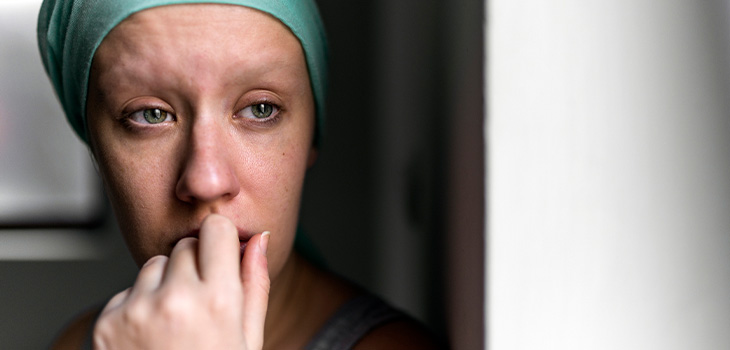
Working-age Australian women diagnosed with breast cancer collectively lose an average of 1.5 years of full-time work for every person diagnosed, costing billions in wages and gross domestic product.
Rising rates of breast cancer among working-age Australian women have prompted urgent calls for action to address the growing impact of financial toxicity.
Financial toxicity describes the negative impact of out-of-pocket costs, indirect costs and the changing financial circumstances of an individual and their household due to cancer, affecting decisions which can lead to suboptimal treatment outcomes.
The economic impact of breast cancer in Australia is vast, research by Monash University shows, and the impact of breast cancer on women’s productivity is profound, said report co-author Zanfina Ademi, Professor of Health Economics at Monash University.
“Despite the five-year breast cancer survival rate in Australia being over 90%, the average woman may lose approximately 50% of her productive paid work time due to absenteeism and presenteeism due to their cancer.
“This has major implications not only for women’s capacity to earn income following diagnosis, but also for broader economic costs to society.”
Out-of-pocket costs can range from a few hundred to tens of thousands of dollars, and can financially cripple cancer patients and their families, especially when one or more people are unable to work within the household.
More than 50% of patients also report a reduction in their household income after diagnosis of cancer, and one in three patients reported ceasing work or retiring due to the diagnosis and/or treatment.
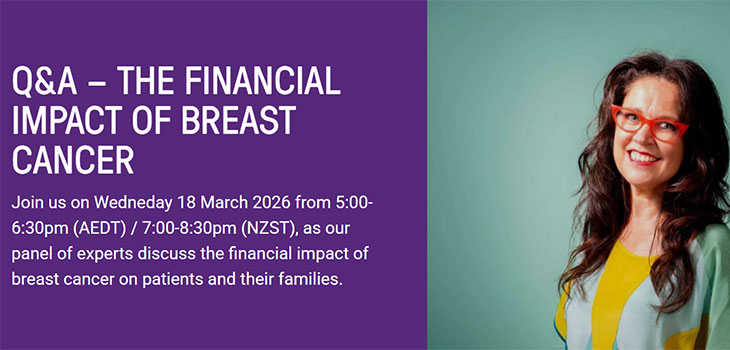
A panel of experts will discuss in a free online Q&A, The Financial Impact of Breast Cancer on Wednesday 18 March from 5-6:30pm (AEST) moderated by author and journalist, Annabel Crabb. The Breast Cancer Trials event will offer important insights and real-world discussion about the financial realities faced by people diagnosed with breast cancer, drawing on the latest in research and real-life experiences.
The financial impacts associated with the most diagnosed cancer in women are both short and long-term, said Karen Price, CEO of Breast Cancer Trials and a member of the NSW Government Women’s Advisory Council.
“We know we have a gender pay gap, and women’s superannuation balances are lower than that for men. The nature of breast cancer treatment in the short term, the impact on the ability to work, and health issues arising from side effects which can persist over a long time, all create health care expenses and loss of earnings for women, some of whom are in the peak of their careers. This exacerbates women’s financial inequality and independence – an issue that can literally alter the course of a woman’s life.”
Alarmingly, nearly a quarter of people with a chronic condition, including cancer, report not receiving recommended care due to the associated costs.
“Improving our understanding of how individual patients and their doctors think, communicate and decide about expensive treatments could help minimise financial harms that are unexpected or unnecessary,” said Dr Deme Karikios, medical oncologist at Nepean Hospital and member of the Clinical Oncology Society of Australia (COSA) Financial Toxicity Working Group.
The Monash University study found that around 10,700 working-age Australians (mostly women) were diagnosed in 2022 with the cohort expected to lose a collective 16,400 productivity-adjusted life years (PALYs) over the following decade. That loss corresponds to roughly AU$1.4 billion in wage earnings and AU$3.26 billion in GDP over ten years, a sobering illustration that the cost of cancer extends far beyond hospital bills.
Participants can register for the Q&A here.





One Response
This article raises many important questions regarding the economic problems facing women who develop breast cancer.
If we lived in a fully supportive society, we would have free health cover for all citizens which would greatly assist these women, but also those suffering from other cancers and long term illnesses.
I visited Cuba many years ago and discovered that although it is not a wealthy nation – an issue made worse by the US blockade – it provides free health cover to all its citizens from the birth until death and free education from recepthion to tertiary.
In addition, it sends medical and nursing brigades to other countries – mostly African and Latin American – to assist with health issues and specialise in dealing with pandemics. Cuba has sent these brigades to Timor-Leste and during the COVID-19 pandemic sent them to Italy as well.
For some time, Cuba has provided free courses to Timor-Leste medical students at its universities.
Australia could do more for its own citizens and people abroad too if our leaders made human needs a greater priority in its economic planning instead of wasting huge sums on military expenditure.
In addition, much more money needs to be allocated to caring for our environment. It could well be that the increase in carcogenic and other toxic substances that are in our soils, water and air may well contribute to the increase in cancers and other serious long term diseases.