

In Australia, mental health statistics for Aboriginal and Torres Strait Islander people remains deeply disproportionate.
In 2018–19, over a third of Indigenous People (37%) reported having a current mental health condition,1 with suicide remaining a devastating issue highlighted in Closing the Gap targets.2
Current data indicate that suicide rates among Aboriginal and Torres Strait Islander people are three times higher than those of non-Indigenous Australians.3 These statistics sit alongside a broader historical and social context, where Indigenous Peoples’ mental health outcomes are shaped by the ongoing impacts of invasion, colonisation, and racism.4
Getting mental health assessment right is therefore critical. Students must be educated about what Westerman,5 an Aboriginal psychologist, identifies as the three serious issues, misdiagnoses, overdiagnoses and underdiagnoses. Westerman5 emphasises when an Indigenous patient is assessed incorrectly, the treatment that follows will inevitably be inappropriate. She urges clinicians to recognise the complexity of Indigenous Peoples mental health and emphasises the importance of approaching assessment with cultural humility, accuracy, and care.5
Nursing and midwifery students play a crucial role in national efforts for ‘Closing the Gap,” in mental health and suicide particularly through the delivery of culturally safe care.2 To do this effectively, students must receive education that deepens their understanding of Indigenous People’s cultural determinants of health.4 Equally important is the need for students to resist deficit-based narratives and instead recognise the resilience, cultural strengths and protective factors that underpin Aboriginal and Torres Strait Islander Peoples social and emotional wellbeing.6 For students, understanding of social and emotional wellbeing demands more than symptom checklists, it requires asking about connection to family/kin, community, culture and country, spirituality, trauma and loss, and acknowledging experiences of racism in healthcare, alongside immediate clinical risk.7 When students integrate these cultural considerations into care planning, they contribute to mental health approaches that are holistic, culturally grounded and aligned with Indigenous Peoples perspectives of health.8
The Nursing and Midwifery Board of Australia (NMBA) Code of Conduct9 outlines clear expectations for culturally safe practice across the nursing and midwifery professions. These expectations must be embedded in undergraduate education, with students taught, supported, and assessed on their understanding, as adherence to the Code is a professional requirement rather than an option. Cultural Safety and respectfulness are responsibilities shared by all nurses and midwives. By embracing these principles, the professions play a vital leadership role in shaping a health system that is free of racism and inequality.10
In addition to Cultural Safety, Tujague and Ryan11 emphasises that Trauma-Informed Practice is critical to supporting the healing journeys of Indigenous People. Trauma-Informed Practice must be embedded across nursing and midwifery education, promoting a strength-based framework that shifts the focus from “What’s wrong with you?” to “What happened to you?”, enabling care that is non-judgemental.11 Furthermore, Cultural Safety and Trauma Informed Practice are strengthened through collaborative approaches to care.12 This includes involving Indigenous health workers with mental health expertise, engaging family where appropriate, and ensuring clear referral pathways for ongoing support after discharge.
Recommendations
The following six recommendations outline key cultural considerations for students caring for Aboriginal and Torres Strait Islander People experiencing mental health challenges.
- Students must:understand Indigenous People’s current mental health statistics and the reasons why they are so dire.4
- Students must:recognise thecomplexity of Indigenous People’s mental health, and approach assessment with cultural humility, accuracy, and care.5
- Students must:acknowledge Indigenous People’s resilience and protective factors underpinned by cultural determinants of health.6
- Students must: employ cultural considerations that contribute to mental health approaches that are holistic, culturally grounded and aligned with Indigenous Peoples perspectives of health.8
- Students must: By embracing these principles of Cultural Safety, the professions play a vital leadership role in shaping a health system that is free of racism and inequality, and genuinely accessible to all.10
- Students must: In addition to Cultural Safety practice, acknowledge that Trauma-Informed Practice is critical to supporting the healing for Indigenous People.12
Students who embrace these recommendations help build a more just, and culturally safe health system. By doing so, our professions shift from merely reacting to the mental health crises toward actively supporting the social and emotional wellbeing of all Aboriginal and Torres Strait Islander People.
References
1 Australian Bureau of Statistics. National Aboriginal and Torres Strait Islander Health Survey, 2018-19 [Internet]. Canberra: ABS; 2019 [cited 2026 Mar 25]. Available from: https://www.abs.gov.au/statistics/people/aboriginal-and-torres-strait-islander-peoples/national-aboriginal-and-torres-strait-islander-health-survey/2018-19
2 Australian Institute of Health and Welfare. Closing the Gap targets: key findings and implications. Canberra: AIHW; 2025. doi:10.25816/gqtf-2k57.
3 Australian Institute of Health and Welfare. First Nations people. Suicide & self-harm monitoring. Canberra: AIHW; 2025 Aug 8.
4 Ward R. Cultural understandings of Aboriginal suicide from a social and emotional wellbeing perspective. In: Best O, Fredericks B, editors. Yatdjuligin: Aboriginal and Torres Strait Islander nursing and midwifery care. 3rd ed. Cambridge: Cambridge University Press; 2021. p. 307-329.
5 Westerman T. Culture-bound syndromes in Aboriginal Australian populations. Aust Psychol. 2021;56(1):27-39. doi:10.1080/13284207.2020.1843967.
6 Australian Institute of Health and Welfare. Indigenous evaluation: Best practices for social and emotional wellbeing and suicide prevention. Canberra: AIHW; 2025. Cat. no. IMH 32. doi:10.25816/gwf9-k613.
7 Dudgeon P, Blustein S, Bray A, Calma T, McPhee R, Ring I. Connection between family, kinship and social and emotional wellbeing. Canberra: Australian Institute of Health and Welfare; 2021. doi:10.25816/jx22-vq08.
8 National Aboriginal Health Strategy Working Party. A national Aboriginal health strategy. Canberra: Australian Government Publishing Service; 1989.
9 Nursing and Midwifery Board of Australia. Code of conduct for nurses [Internet]. [cited 2026 Mar 25]. Available from: https://www.nursingmidwiferyboard.gov.au/Codes-Guidelines-Statements/Professional-standards/Code-of-conduct-for-nurses.aspx
10 Congress of Aboriginal and Torres Strait Islander Nurses and Midwives, Nursing and Midwifery Board of Australia. NMBA and CATSINaM joint statement on culturally safe care; 2018. Available from: https://www.nursingmidwiferyboard.gov.au/codes-guidelines-statements/position-statements/joint-statement-on-culturally-safe-care.aspx
11 Tujague NA, Ryan KL. Ticking the box of ‘cultural safety’ is not enough: Why trauma-informed practice is critical to Indigenous healing. Rural Remote Health. 2021;21:6411. doi:10.22605/RRH6411.
12 Gupta H, Tari-Keresztes N, Stephens D, Smith JA, Sultan E, Lloyd S. A scoping review about social and emotional wellbeing programs and services targeting Aboriginal and Torres Strait Islander young people in Australia: understanding the principles guiding promising practice. BMC Public Health. 2020;20(1):1625. doi:10.1186/s12889-020-09730-1.
Authors
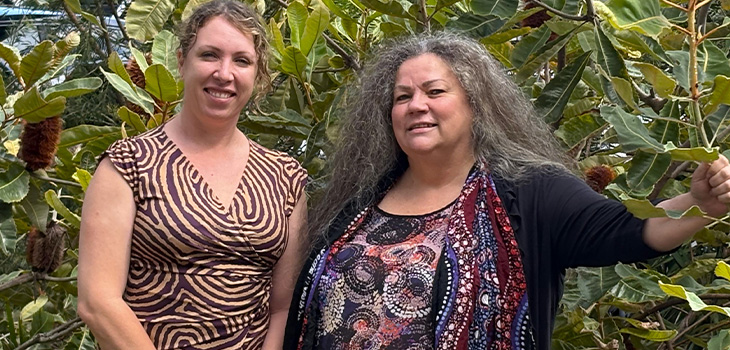
Naomi Howell (Eora/Wiradjuri Woman) Lecturer – Nursing, School of Health, UniSC, Sippy Downs Campus, Qld
Lynne Stuart (Mandandanji Woman) – Senior Lecturer – Nursing, School of Health, Academic Lead – Aboriginal and Torres Strait Islander Curriculum Advisor, UniSC, Sippy Downs Campus, Qld