

As Australia shifts into designated registered nurse prescribing, many nurses are asking what it will look like in practice and whether the extra risk and responsibility is worth it.
New Zealand RN community health prescriber Claire Stewart believes the benefits are clear.
“Don’t be frightened,” she says.
“Think about the positives. How this will enhance your practice and remove barriers for people who may not otherwise be able to see a doctor.”
Claire, who completed a Bachelor of Nursing degree at Griffith University in 1994 and a Graduate Diploma of Midwifery in 1999, always had a strong interest in women’s health. After working in Brisbane, she returned to her native New Zealand in 2012 before joining Sexual Wellbeing Aotearoa, the country’s largest provider of sexual and reproductive health services.
At the predominantly nurse-led clinic, which provided all forms of contraception, sexually transmitted infection (STI) treatment and cervical screening, RNs could supply or administer medicines under standing orders – written instructions issued by an authorised prescriber such as doctor or nurse practitioner.
In 2017, Claire and her colleagues took part in a pilot program to develop RN prescribers in community health alongside the broader introduction of RN prescribing in New Zealand.
Training involved completing an education program approved by the Nursing Council of New Zealand covering topics such as pharmacology, medicines management, prescribing and the law, and case studies. Once endorsed, RN community health prescribers can prescribe a limited number of medicines for minor ailments and illnesses for normally healthy people who do not have significant health problems.
Claire admits that, at first, prescribing under her own name didn’t feel like a massive change. But over time, her perspective shifted.
“As time passed, and various medicines were added to the community prescribing list, and we could order our own bloods and swabs, I started to feel a change in my practice – perhaps a deeper sense of responsibility,” she reveals.
New Zealand has three levels of prescribing authority for nurses and each has its own educational requirements and scope. Nurse practitioners (NPs) are autonomous prescribers with Masters level education who can diagnose, treat and prescribe within their scope. RN prescribers – primary health and speciality teams must complete a postgraduate diploma and only prescribe from a limited list of medicines for common and long-term conditions. Community health RN prescribers like Claire have completed an education program and can prescribe from a smaller medicines list. Some other nurses can also prescribe a limited range of medicines in specific areas, such as diabetes treatment, the emergency contraceptive pill, and Hepatitis C medication.
Latest data from the Nursing Council of New Zealand shows there is 2,571 nurses with some form of prescribing rights. Of these, 913 were nurse practitioners, 1,442 were registered nurses with limited prescribing rights, and 199 were registered nurses who were only able to prescribe the emergency contraceptive pill.
Claire says she was able to appreciate the full value of prescribing after leaving SWA and moving into a community-based role working with patients experiencing multiple barriers in accessing healthcare, particularly women’s and sexual health. Working at Middlemore Hospital in South Auckland, she helped set up community clinics providing postnatal contraception and women’s health for a cohort who “just otherwise wouldn’t be seen”.
“That’s when prescribing really came into its own,” she suggests. “I could prescribe a Mirena (Intrauterine Device) for contraception, insert it, and provide a script for pain relief. I could treat a couple for an STI who otherwise may not have accessed treatment. If a child came in unwell and needed paracetamol, I could provide it.”
“These people just wouldn’t go to a GP. They probably wouldn’t go to a sexual health clinic because of cost. And not just because of the cost of the appointment, but the cost of petrol to get there. It’s all about access, equity and equality. Nurse prescribing just removes many barriers. It gives people more options and choice.”
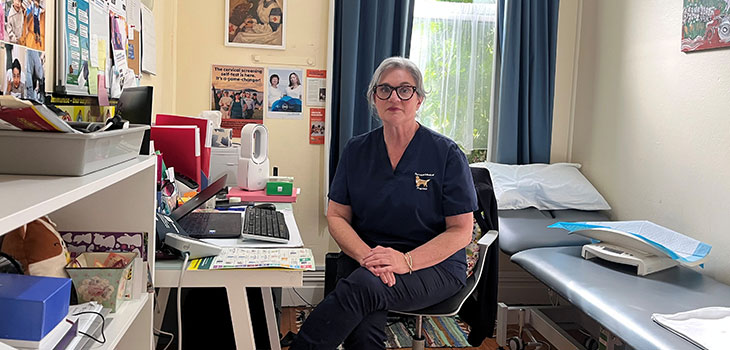
Now working as a general practice nurse in Dunedin, Claire describes prescribing as “an integral part” of her role.
“I see otherwise well patients, who can see me instead of a GP,” she explains.
“We have lots of babies and young families here, so I often see children for common ear infections. They might need Panadol or vitamin D drops – all these sorts of things I can prescribe. I also do all of the women’s health and prescribe for that as well.
“It works really well. I think the big thing is the continuity of care, and it also removes barriers. Seeing a GP here costs about $55, whereas people can see me for $25.”
While nurse prescribing is already well established internationally, the introduction of designated registered nurse prescribing has generated considerable discussion among Australian nurses.
Claire says she understands why some nurses are apprehensive, but points to the significant benefits and strong safety nets.
“I think there seems to be this misconception that once you’re a prescriber, you can just go out there gung-ho and prescribe whatever you like, and it’s just not like that,” she suggests.
“As a group, nurses are actually quite conservative prescribers and make very few mistakes.”
Endorsed designated RN prescribers in Australia will need to complete an additional 10 hours of continuing professional development (CPD) relevant to their endorsement for scheduled medicines each year. For Claire, recertification involves completing 60 hours of professional development every three years, including 20 hours on prescribing.
“Once a month, I meet online with other nurse prescribers in Dunedin,” Claire says.
“It’s a really safe space where we present case studies, talk about things that have happened, any changes to medications, and just reflect on our practise. We also get someone who we are working with, usually an NP or GP, or another prescriber, to provide a statement saying that we are prescribing regularly and that our prescribing meets the standards set up by the nursing council.”
“It’s cost-effective for the patient and time-effective for the GP. Nurses are more than capable of prescribing medications for patients. As a group, we are safe and conservative prescribers.”
Pay for the extra study, risk and responsibility that comes with designated registered nurse prescribing is another question Australian nurses frequently raise.
Claire’s says experiences in New Zealand have been mixed – some prescribers received a small hourly increase, some negotiated a remuneration “package”, and others saw no change at all.
While she believes nurses should be paid more for prescribing, Claire says the real positives are faster treatment, greater continuity, and fewer barriers to care.
“It really establishes a deeper sense of responsibility and commitment to your work,” she says.
“How often has a nurse gone to a doctor and said, ‘That patient needs a script for this, can you please write it?’ and they write the script? That situation could almost disappear.”