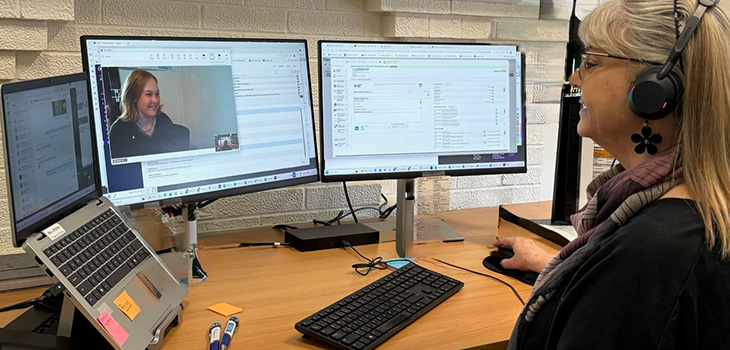


As artificial intelligence (AI), virtual care and digital technologies redefine Australia’s health system, nurses and midwives must be at the centre of the conversation to ensure innovation strengthens patient care without replacing the human touch.
That was the message from chair of the ANMF’s Digital Health Advisory Committee, Alice Kett, who outlined the union’s evolving digital health strategy during a session at the ANMF (Vic Branch) Nurses’ and Midwives’ Conference earlier this year.
While digital health has become one of healthcare’s fastest-moving areas, Alice, the ANMF’s Strategic Lead – Education, stressed it was important to remember that digital health tools can never replace the expertise and human connection at the heart of nursing and midwifery.
Reflecting on an experience in her nursing career while working at a hospital, Alice recalled caring for a patient named Myra* in severe pain who simply needed someone to sit beside her and offer comfort.
“Two other staff members went to check some meds for her, and once I knew that help was on the way, I just felt compelled to cuddle up into the bed beside her and put my arms around her,” Alice told delegates.
“She immediately burst into tears and said, ‘I haven’t been hugged in ages. Sometimes you just need a cuddle’”
The career-defining moment reinforced why Alice became a nurse: to ease discomfort and meet people where they’re at.
“When I think about Myra*, I want to be very clear digital health could not have cuddled Myra*,” Alice said. “She needed a nurse in the room at that moment.”

Digital health technology, however, could have improved other aspects of the patient’s care, explained Alice, such as quicker access to pain relief, better access to clinical history, and enabling earlier recognition of her worsening pain.
“These are tools to assist what we do, but they cannot replace our expertise as nurses and midwives.”
What is digital health
Established last year, the ANMF’s Digital Health Advisory Committee analyses emerging digital health developments, anticipates workforce impacts and advocates nationally for policy settings that both safeguard members and unlock opportunities to strengthen practice and patient care.
Alice said digital health encompasses far more than AI, covering everything from telehealth and virtual care to handover and communication practices, and tools that can be used to collect and share a patient’s health information.
As these systems become embedded in everyday practice, in everything from assessments to documentation, Alice said digital capability is becoming an essential professional capability for nurses and midwives.
“Before, if you really hated a particular system because you hate computers in general, it was probably possible to find a workaround and avoid doing that,” she said. “I think that time is well and truly behind us.”
Shaping digital health together
Amid the rapidly evolving digital health landscape, Alice said the ANMF is working hard to better understand how members are engaging with digital health technologies in practice.
Feedback gathered through the Digital Health Committee shows opinions vary widely, with some members embracing new technologies while others remain curious, uncertain or scared.
“We need to know more about what gaps and opportunities there are for our members, and this is really important because not engaging with digital health, or over-engaging, can have consequences.”
“Our regulatory bodies haven’t really done enough yet to address the unique impact of rapid tech developments like AI on our professions,” Alice argued.
“We need to start thinking about things like transparency, fairness, accountability, and safety, and what they mean to us and our professions because adoption is happening whether we’re in the room or not.”
Tell us your concerns and curiosities about digital health
Take the ANMF Digital Health Strategy Survey to help us understand where we can shape reform and lead.
Link – ANMF Digital Health Strategy – Fill out form

Keeping pace with change
Rather than ignoring this reality, Alice said nurses and midwives need practical guidance and robust governance to ensure new technologies are used safely and transparently.
She highlighted that many existing digital health policies focus heavily on organisational priorities such as privacy and data storage while failing to address the realities of frontline clinical practice and what matters most at the bedside.
Alice believes nurses and midwives must help shape how digital health is integrated into practice, ensuring it creates more time for care rather than competing with it.
“It [digital health] should support decisions, not replace judgement,” she told delegates.
“It should improve what we do. It’s a tool, and it can’t hug Myra*.” Citing Nick Marlow, Research Fellow at the Rosemary Bryant AO Research Centre, Alice added – “Digital health should scaffold our expertise, not replace it,”
With AI and digital health showing no signs of slowing down, Alice said nurses and midwives have an opportunity, and a responsibility, to influence how systems are designed and implemented.
The ANMF’s Digital Health Committee has identified several areas of focus. Digital systems should create more time for patient care rather than increasing administrative burden, support clinical decision-making without replacing professional judgement, and ultimately improve the quality and accessibility of care.
ANMF branches will continue developing practical resources and advocacy to help nurses and midwives navigate digital transformation.
“We can’t stop digital health,” said Alice. “But we can try and understand where our voice is needed, where you feel vulnerable, where we can shape reform and where we can lead.
“When it [digital health] is done well, it can lead to safer, more connected, more accessible care.”